Author Archives: Israelfortourists

Hanukkah; a festival of lights

It is being celebrated for eight days from the 25th day of the Jewish month of Kislev (in December) and is commemorating the re-purification of the Jewish Temple in year 165 BC, by the Maccabees, after its desecration by enemies of the Jewish state.

In Hebrew, the word “hanukkah” means “dedication.” The name reminds us that this holiday commemorates the re-dedication of the holy Temple in Jerusalem following the Jewish victory over the Syrian-Greeks in 165 B.C.

Hanukkah Traditions-

Common traditions that are almost universally practiced, by Jews around the world are:

Lighting the hanukkiyah; in order to commemorate the miracle of the Hanukkah-oil, by lighting candles on a hanukkiyah;

Spinning the dreidel; a popular Hanukkah game also commemorating the miracle of the Temple;

Eating doughnuts filled with Jam


The Ramon Crater

The Ramon Crater, also called in Hebrew “the Makhtesh”; is a unique Geological Phenomenon that is rare in the Middle Eastern parts, which had been created due to the erosion of a Mountain that had been filled with soft stone.

The Phenomenon had started about 110 million years ago. The Hebrew term of “Makhtesh” can be translated onto the English work “Crater”, as a geological Phenomenon, initially created by a Meteor. Visits to the Ramon “Makhtesh” could last from several hours up to four days.

I strongly recommend the Promenade along the Crater’s cliff; also visit the Sculpture garden; take a night’s stroll to enjoy the numerous shining starts and mainly –  do not be lazy; rise in early morning hours in order to watch the Sunrise; it’s a pure Genesis breathtaking view to remember!

This article had been brought to you by Hilik Wald, Israel Tour Guide.

In the vicinity of this site you may also want to visit Sde-Boker; Eilat or the Timna Valley-Park...


The Golan Heights – Beauty and Strategy

The Golan Heights is an area that is located in the north-eastern part of Israel; a plateau overlooking the northern Valleys in Israel as well as the South western parts of Syria.

Its history dates back to Biblical times;

acting mostly as a buffer zone of the ancient Kingdom of Israel. During the following centuries, the plateau changed many hands including Alexander the Great as well as the Roman Empire.

The area eventually settled under the control of the Ottoman Empire in the 16th century.

After WW2, the French mandated that ruled Syria- at the time -had annexed the area, including it within its new borders, hence, Syrian territory.

After the establishment of the state of Israel in 1948, Syria took advantage of the area’s high terrain and began shooting at the Galilee’s valleys of Israel, below. After years of bombardments, Israel seized control of the Golan Heights

during the 6-day War in 1967. Israel has immediately started to build new settlements and made use of the high ground to monitor Syrian activity below.

Syria has repeatedly attempted to regain the Golan Heights. A devastating war – to all parties had taken place in 1973, but all attempts: military as well as politically have proven fruitless.

These days, there are some 20,000 Israeli inhabitants aside some 20,000 Syrians- most of them members of the Druze sect. The Capitol City of the Golan is Katzrin. The Golan is also a key source of water. The area provides a third of Israel’s water supply.

The land is very fertile, based on some former volcanic soil – which is used for vineyards and orchards as well as raising cattle.

Main Attractions in the Golan-worth exploring:

Rafting in the Jordan River –
After buckling up with safety belts, it is a pure pleasure entering the river. You can choose between a kayak or a rafting boat. The sail is mostly independent, passing through some spectacular landscape.

Jeep Tours-
Various Jeep tours are available in the Golan; mostly day tours alongside some extreme tours. This mode of excursion is one of the recommended ones in the Golan as it not only roams through the country but most of the instructors/guides also explain the history, nature, and

Horse Riding-
Various operators offer a variety of Horse riding in the Golan; it could be a 1-2 hours’ ride or a day’s tour.

Fruit self-picking
A variety of Kibuttzim/Moshavim offer a self-service adventure in picking fruit; you can eat it on spot or bring a full basket home.

Biking tours-
Bicycle tours in the mountains, through the tware or on haref terrains, are very popular in the Golan.

The Old Katzrin Park and The Museum of Antiquity The museum is located I the city of Katzrin at the Park of ancient history. Both sites aim at guiding the visitors through the ancient times, in both Jewish and Christina tradition.

Contact Details:
The park: +972-4-6962412
The museum: +972-4-6964664

The Magic of the Golan (“Kesem Hagolan”) – visitor’s center
This new visitor’s center is located in the city of Katzrin, enabling to get a glimpse at the variety of nature, people, landscape and political venues of the Golan Heights.

Main attraction are a movie (in several languages) portraying the Golan’s geography, landscape and sights; a unique and modern Model of the Golan including sound and light explanations and a Brew-house restaurant that offers Israeli means alongside its very own brewed Beer.
Contact Details: +972-4 -6963625

In the vicinity of this site you may also want to visit Mount Hermon; Safed; or Rosh-Pinna….


The Roman Catholic and Uniate Churches

The Roman Catholic and Uniate churches are located in Jerusalem; adding to the city’s glory.

The churches that are in communion with Rome and recognize the primacy and spiritual authority of the Pope (who as bishop of Rome holds the ancient patriarchy of the West). In matters of liturgy, the Eastern churches in communion with Rome follow their own languages and traditions.

Whatever the early relations between Rome and Constantinople, there was no attempt to establish a Western Church in the Holy Land independent of the existing Orthodox Patriarchate until the establishment of the Latin Patriarchate of Jerusalem during the Crusader kingdom (1099-1291).

The office of the Latin Patriarch was reconstituted in 1847. Until then, responsibility for the local church rested with the Franciscan Order, which has served as Latin custodian of the holy places since the 14th century.

Today a bishop, recognized by the title of patriarch, heads the Latin Patriarchate of Jerusalem. Three vicars, residents in Nazareth, Amman, and Cyprus, assist him. In past recent years there is a fourth vicar who represents the Hebrew-speaking congregations within Israel. In popular parlance, local Roman Catholics are referred to as “Latins”, in reference to their historic liturgical language. Since the Second Vatican Council however, the Roman Catholic liturgy is generally celebrated in the vernacular, except at some of the holy places, such as the Church of the Holy Sepulcher and the Church of the Nativity, where the mass and other services are still celebrated in Latin.

The article- courtesy of RLH


Bet She‘arim National Park

Bet She‘arim is a ancient Jewish cemetery of the era that is called the “Mishna”, in Jewish history.

It is situated at the lower Galilee (northern part of Israel).

The uniqueness of the site stems from the fact that ancient people had carved into the hill and created tombs – deep inside the hills.Archaeological finds show ancient courtyards, corridors and even steps- that lead to large halls; at which burial chambers and stone coffins can be found.
In addition there are carved writings as well as paintings that reflect Jewish life at that era.


The time frame is presumed ot be around the 3rd century CE, at which Bet She‘arim served as a Jewish corner ton at which Rabbis and students used to live & study.
The most famous one at the time was Rabbi Judah Hanasi, who acted as head of the “Sanhedrin”- the Jewish high-council.
Directions:
The site is just off road no. 75, North; a mere ten minutes from the center of Kiryat- Tivon.

Tel: +972-4-983-1643


Haifa Zoo

The Haifa Zoo is named after Louis Ariel Goldshmidt.

It started off as a petting ground/corner in mid-1940, by Mr. Pinhas Cohen who was one of the fascinating Biology teachers of Haifa.

Throughout the years it filled with animals and is nowadays known as the “Haifa Educational Zoo”.

The zoo contains a variety of birds, predators, reptiles, and some other 100 species.
The zoo had undergone massive renovations, in year 2002, thanks to local donations.

The zoo is located adjacent to the Carmelit station called “: “Gan-Ha’em”

Tel. +972-4-8372390 / 8372886
Address: 124 Hatishbi Street, Haifa

Opening hours:
Sunday-Thursday 0800-1900
Fridays- 0900-1500
Saturday-0900-1600


Sukkot

The Jewish holiday of Sukkot will be celebrated this year between September 27-October 6, 2015.

Sukkot is one of the three Biblical traditional holidays of pilgrimage; an agricultural festival that originates from the Bible days and is considered a thank you tribute for the fruit harvest.

Sukkot is the “Feast of Ingathering.” (Exodus 34:22) On a spiritual level as well, Sukkot brings along the opportunity to survey our resources and take stock of our abundance. In full recognition of God’s role in the productivity of our lives, we express gratitude that in an often-tenuous world, we are being sustained. How can we acknowledge in a continual way our thankfulness that our lives are sustained? We acknowledge our gratitude through food.

For our ancestors, daily and festival offerings of animals and of produce were the primary way to sanctify God. However, in contemporary Jewish life, there is always the opportunity to sanctify God through food.

By thanking God for sustenance, the most basic necessity, we elevate our most basic daily activity to the highest level of sanctification. And this is one of the Sukkot messages we can carry with us throughout the year.


Yom Kippur

Yom Kippur occurs this year on Wednesday, September 23, 2015.

This very important fasting day begins at sunset on Tishri 9 and lasts until three stars appear after Tishri 10.

Yom Kippur is the holiest day in the Jewish calendar.

The observance is also known as the Day of Atonement since the events of Yom Kippur focus on asking and granting forgiveness for one’s transgressions. Yom Kippur falls at the end of the ten Days of Penitence which begin with Rosh Hashanah, the Day of Judgment.

Jews attend services at a synagogue or temple on the eve and day of Yom Kippur.

The Kol Nidre, a prayer which asks forgiveness of sins, is recited on the eve. Prayers which emphasize cleansing of the soul are recited during the day services. Congregants mourning family members who died in the past year recite Yiskor prayers in which God’s forgiveness is asked for the deceased.

On Yom Kippur, a fasting day, Jews from all over the world perform no work and abstain from food and drink.


The Jewish High Holidays

The time period between Rosh Hashana, the Jewish New Year and Yom Kippur– the holiest day in Judaism, a fasting day – these days are called: The (Jewish) High Holidays.

The meaning of this time period stems from the fact that these are days of repentance; it is a time of reckoning, of request of pardon from those we have hurt and a period of reflection of the passing year and the forthcoming one: where did I go wrong? How do I do better?

It is especially a time of repentance between people, while God is summarizing his years when judging each person at his own time, per his own actions.

In his article “Feast of the Trumpets remembers world’s creation”, David Johnson states that:
“…. Rosh Hashanah is not one big party, as the New Year’s celebrations on Dec. 31 tend to be. Rosh Hashanah is a time for personal introspection and prayer.

Jews may also visit graves. It is thought that the prayers or good wishes of the dead can help the living. By wishing each other well and sending cards, people let friends know what happened in the past year and what plans lie ahead. Christmas cards and get-togethers fill a similar role for Christians.

Rosh Hashanah is part of a process of spiritual growth. The Hebrew month preceding it, Elul, is a time for charity, tzedakah. Rosh Hashanah falls on the first and second days of the seventh month, Tishri.”


The Armenian Orthodox Church

The Armenian Orthodox Church dates from the year 301 and the conversion of Armenia, the first country to embrace Christianity.

An Armenian religious community has been present in Jerusalem since the 5th century. The Armenian Patriarchate of Jerusalem was established in 1311.

Throughout the 19th century and during and immediately after WWI, the local Armenian community grew with the absorption of survivors of the Anatolian massacres.

Before 1939 the community numbered more than 15,000, and was the third largest Christian group.

Today the community numbers about 4000 in Jerusalem, Haifa, Jaffa, and Bethlehem.

The article- courtesy of RLH


The Ethiopian Orthodox Church

The Ethiopian Orthodox Tewahedo Church has maintained a presence in Jerusalem for more than 1,500 years.

There are claims that there has been representation of the Church in Jerusalem ever since the famed meeting of the Queen of Sheba and King Solomon some 3,000 years ago. The Church is the predominant Oriental Orthodox Christian Church in Ethiopia and was part of the Coptic Orthodox Church until 1959.

In the 19th century, a succession of powerful Ethiopian monarchs decided to establish a strong presence outside Africa. In 1888, Ethiopian Emperor Yohanes bought a large plot of land and began construction of a new church and monastery outside the walls of the Old City.

The complex eventually lent its name to the road on which it is situated – Ethiopia Street.

The article- courtesy of RLH


The Sarona Market

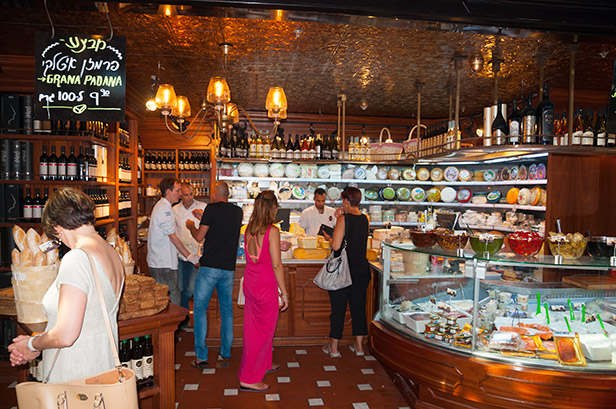
The Sarona Market was created in order to serve as the newest culinary heart-beat of Tel-Aviv.

It is located at the Sarona compound, a 140 year-old ex-Templer- settlement in the heart of Tel-Aviv.
At the time, German Templer-settlers arrived in Tel-Aviv in aspiration of pious-missionary Christian activities. Sarona had been their third settlement in Palestine.

The Templers had transformed the little hill that overlooked the Mediterranean Sea into a growing agricultural settlement that quickly shifted the city’s new citizens’ life to both commerce and leisure.
The area stretches in between Klan and Hashmonayim streets, near the Ayalon River and main route.

In year 2006 a plan to preserve 36 historical buildings was approved, in order to return the former façade from the time of the Templer- settlement.

Work has been underway in full speed so as to finish all designs and refurbishments in order to enable a new cultural center, in the original Templer spirit that will be influenced by the modern style and energy of contemporary Tel-Aviv.

The Sarona compound offers a center for culture, leisure and shopping and its visitors’ center tells the story of the turbulent history and its important place as a national heritage site.
Nowadays, the market consists of some 90 -of the finest -stores, food-stands and restaurants, that offer visitors the best of culinary dishes in the country.

The market combines between old and new; Gourmet and daily dishes, Israeli as well as international styles of all kinds: wines, chocolates, vinaigrette, fruit, spices, bakery and more…
The market had been influenced by international markets such as The Chelsea Market of NYC, and La Boqueria; of Barcelona etc.